
Search Intent Keyword Classifier Data Studio template
Best for: For SEOs, content marketers and content strategists who want a keyword list sorted into search intent groups in minutes, whatever tool the keywords came from.
Inside the report
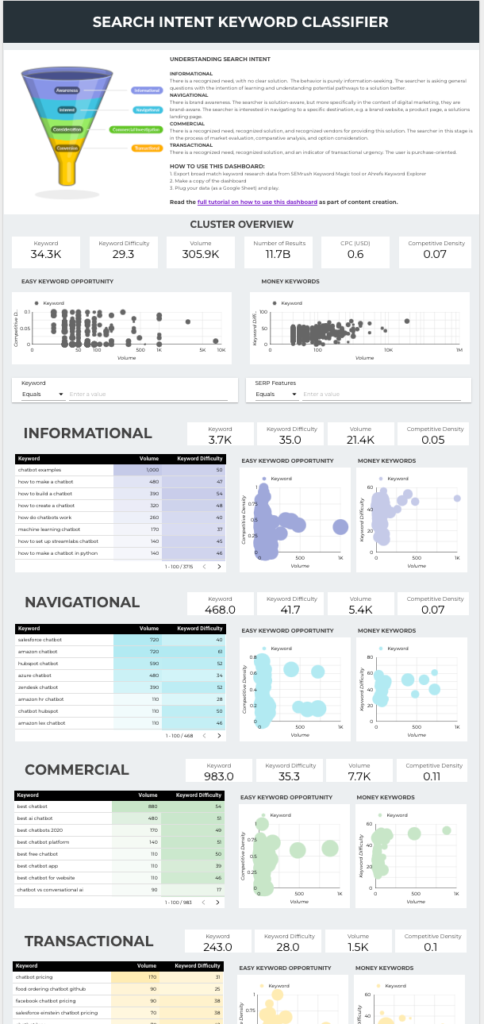
Overview
Keyword research is a task most SEOs do daily. Yet even though we know content that addresses search intent is crucial to how it performs, there's little effort to bring search intent into the research process itself. I built this free Data Studio template in 2021 as a stepping stone in that direction.
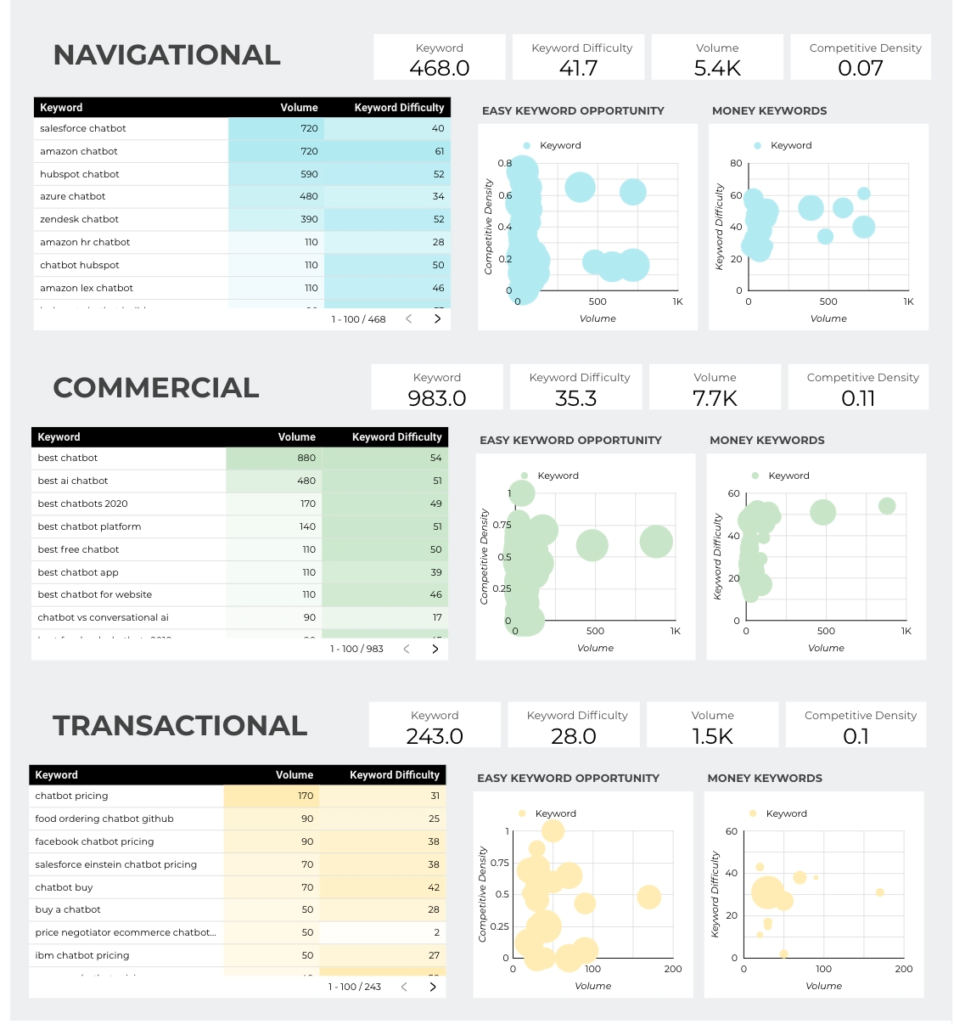
Connect a keyword export as a Google Sheet and the dashboard classifies keywords into informational, navigational, commercial and transactional groups, with adaptable filters built on intent-signalling terms. Each group gets its own scorecards (keywords, keyword difficulty, volume, competitive density), a keyword table and two scatter charts: easy keyword opportunities (volume against competitive density) and money keywords (volume against keyword difficulty).
It's designed for content creation as well as content planning: it helps SEOs, content marketers and content strategists understand the intent behind each keyword cluster faster. The demo uses a Semrush export, but any keyword source works.
What people say
Wow, Lazarina Stoy's system for keyword research is one of the most detailed and automated that I've seen so far! 👌 🔬
What a useful Google Data Studio Dashboard allowing to easily segment and classify your keywords intent by @lazarinastoy 👏 check it out
This is an amazing dashboard + process for search intent classification. Well done @lazarinastoy 💪🏻
Who it's for
For SEOs, content marketers and content strategists who want a keyword list sorted into search intent groups in minutes, whatever tool the keywords came from.
Questions it answers
- How does my keyword cluster split across informational, navigational, commercial and transactional intent?
- Which keywords are easy opportunities, with volume and low competitive density?
- Which money keywords have volume at a difficulty I can compete for?
- What intent do sub-topics and long-tail keywords show?
- Which keywords trigger a given SERP feature?
Key features
- Cluster overview: keywords, keyword difficulty, volume, number of results, CPC and competitive density
- Four intent groups from adaptable filters
- Easy-keyword-opportunity and money-keyword scatter charts for each intent
- Filter keywords by related terms, for sub-topics and long-tail keywords
- Filter keywords by SERP feature
- Prioritise by keyword difficulty, CPC and search volume
Set it up in minutes
- Export broad-match keyword research data, for example from Semrush's Keyword Magic Tool or Ahrefs' Keywords Explorer, into a Google Sheet.
- Open the Data Studio template and make a copy.
- Connect your Sheet as the data source, and explore.
- Tune the intent filters with terms that fit your market. My tutorial walks through the process: https://www.mlforseo.com/machine-learning-implementation-guides/serp-analysis/search-intent-classification-with-machine-learning-approaches/